A Luckenbooth is a small Scottish brooch in the shape of a heart, often with a crown on top, and sometimes two hearts linked together. For a few hundred years it has been a love token, given to a sweetheart and later handed on to a child. It’s a lovely thing to bring into a Las Vegas wedding or vow renewal, because it’s small, personal and easy to fit into a ceremony of ten to fifteen minutes.
I’m Irish and Scottish by background, and I lived for a while in the north of England, so Scottish traditions have always felt close to home for me. When couples tell me they’d like something from Scotland in their ceremony, the Luckenbooth is one of my favourite ideas. Here is what it is, where it really comes from (some of the popular story isn’t quite right), and how you could include one on your day.

How Do You Pronounce Luckenbooth?
It’s a mouthful the first time, so let’s get it out of the way. The standard English dictionaries give it as LUK-en-booth, with the stress on the first part, “luk” as in “luck”, and the last part like “booth”, with the soft “th” you hear in “this”.
The pieces are Scots words, which helps it stick. “Lucken” is the old Scots word for locked or fastened, and the Dictionary of the Scots Language gives its sound as “LUK-en”. The “booth” part is the old word for a stall or small shop. In older Scots it was spelled “buith”, and the same dictionary records a sound rather like “booth” said with rounded lips, a bit like the French “u”. You’ll still see that spelling in old Edinburgh records. Today most people simply say “booth”.
One small thing worth knowing: the dictionary notes that “lucky-booth” is a mistake, however natural it sounds. No one will mind if you say it, but now you can say it the proper way.
What a Luckenbooth Looks Like
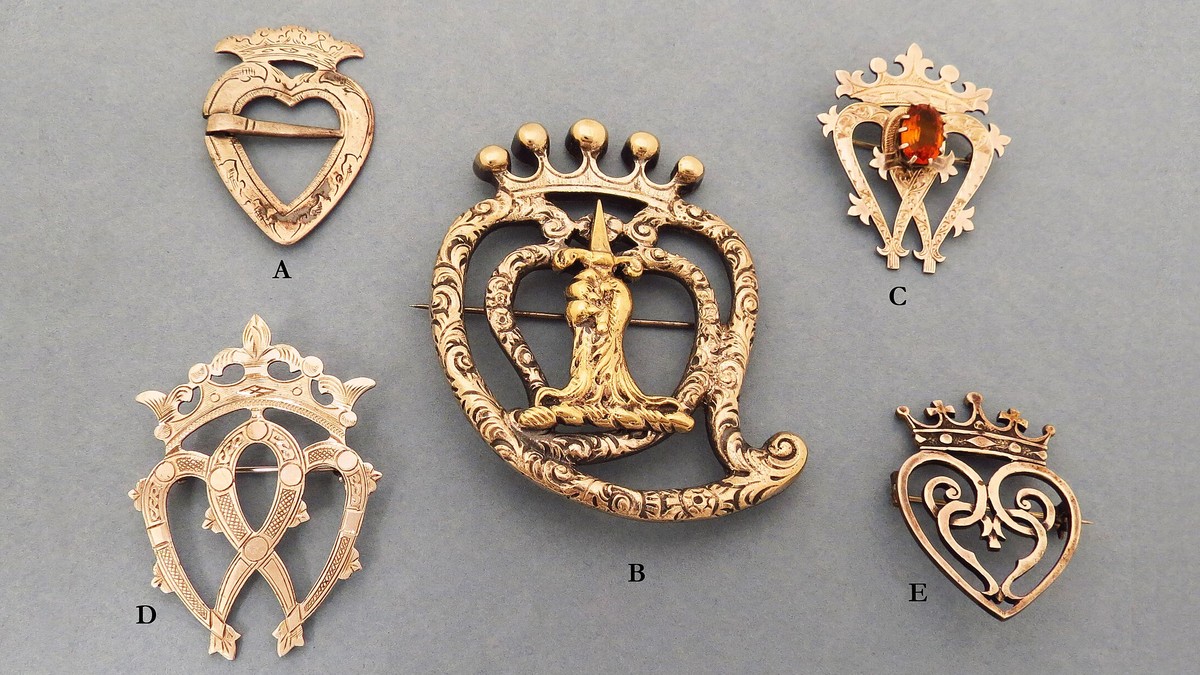
Most Luckenbooths are made of silver, though a few early ones are gold. They’re a heart with a hollow middle, fastened with a simple pin. Some are plain. Others are engraved, set with a coloured stone, or made with two hearts interlaced. A crown sits on top of many of them.
You’ll often hear that each part has a meaning. The heart stands for love. Two hearts joined together stand for two people becoming one. The crown is usually said to mean loyalty. These meanings are the ones jewellers and families have given them over time, so think of them as a lovely tradition rather than a strict code. Many also carry two sets of initials, which is a very old Scottish way of marking a marriage, and you’ll find it on door lintels and quaich handles as well.
Some modern designs add a thistle, Scotland’s national flower, which is a more recent touch.
Where the Name Comes From
The word is older than the brooch. The Luckenbooths were a row of lockable shops, “lucken” being the Scots word for locked, that stood on Edinburgh’s High Street on the north side of St Giles’ Kirk. The row began in the 1400s, with the name written down by the early 1500s, and these were among the city’s first permanent shops, home to goldsmiths and jewellers among many other trades. The last of the block was pulled down by 1817 to widen the street.
It’s a neat story that the brooches were all made and sold there, and the name has stuck. But when Lyndsay McGill of National Museums Scotland studied more than 350 Scottish heart brooches for a 2022 paper, the picture was more interesting. Brooches clearly made in Edinburgh turned out to be surprisingly rare. No Edinburgh-made one could be securely dated before 1830, well after the booths were gone. The name “Luckenbooth brooch” doesn’t seem to appear before the late 1800s, and may have been coined by Victorian collectors or sellers who liked the romance of it. Far more brooches were made in the north of Scotland, especially in Inverness and Aberdeen, from the middle of the 1700s into the early 1800s.
I find that rather lovely. It means the brooch belonged to ordinary families across the whole country, not just one street in the capital. Many were passed down and later given to museums with a family story attached.
How Old Is the Heart Brooch?
The heart-shaped brooch is older than the name. A handful of medieval heart brooches have been found in Scotland that may date from as early as the 1200s. Royal records from 1488 and 1503 mention heart brooches and a heart of gold. The great majority of the brooches that survive, though, date from about 1700 onwards. In the 1800s they grew larger, with interlaced double hearts, and tiny ones set with stones became fashionable. Some were made by travelling metalworkers, one from the bowl of a spoon, and old stone moulds for casting them have been dug up in Wigtownshire.
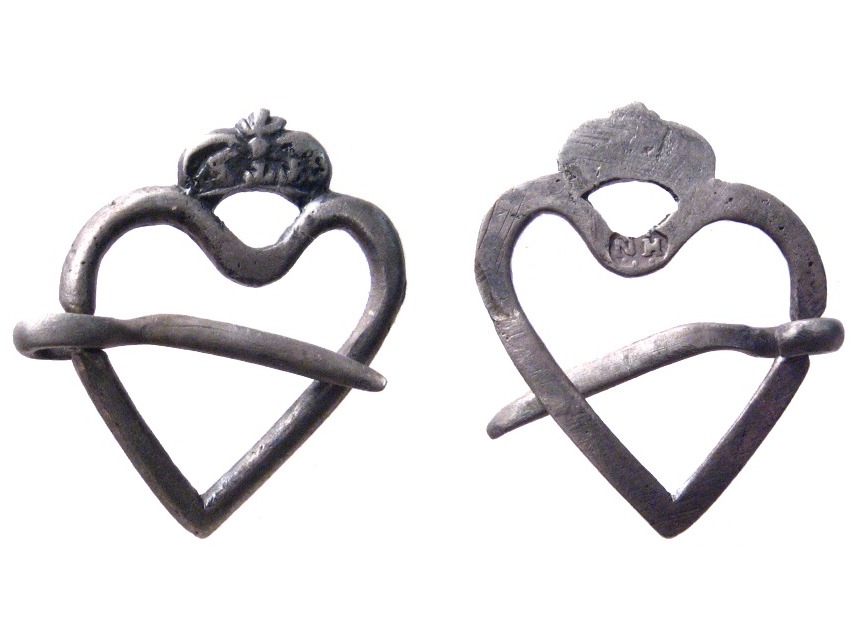
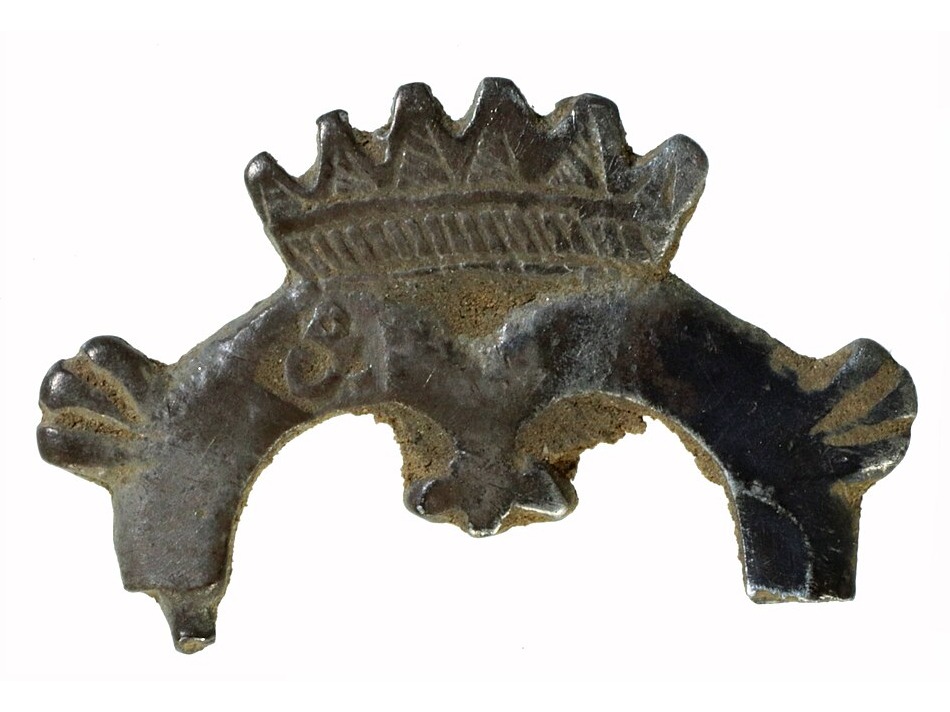
The style wasn’t only Scottish. Crowned hearts turn up in Norway too, and some have turned up in England too. The two below were found in Kent and Norfolk and recorded under the Portable Antiquities Scheme.


The Mary, Queen of Scots Story
You may have heard that a Luckenbooth was a gift from Mary, Queen of Scots to Lord Darnley, or that she received one from the young Dauphin of France. It’s a lovely tale, but I’ve not found any evidence for it. I’d call it a legend.
There’s one possible clue to where it came from. In the 1800s, large double-heart brooches were sometimes called “Queen Mary brooches”, because the joined hearts under a crown look a bit like the letter M. That was at a time when people were enjoying the romance of Mary’s story again. So the legend may be a Victorian one, and the brooch itself is part of a much wider and humbler tradition of Scottish heart brooches.
What They Were Used For
As love tokens. This is the best-known use and it’s well supported. Many surviving brooches are engraved with little verses such as “my heart you have and yours I crave” or “let love abid till divid”. Some carry the initials of a couple, and a few refer to the Book of Ruth: “whither thou goest, I will go”. A few say “a friends gift”, which is a nice reminder that love comes in many forms.
As protection. In folk tradition, small heart brooches were pinned to a child’s clothing, often out of sight on the underside of a petticoat, to guard against the evil eye and witches. They were sometimes called “witch brooches”. A brooch given to the National Museum in 1893 was said to have been worn on the chemise by the donor’s grandmother, to stop witches taking away her milk. I’d treat these as folklore handed down in families, not as anything proven, but they show how much people treasured these little hearts.
Including a Luckenbooth in Your Las Vegas Ceremony
None of this changes the legal side of your day. A Luckenbooth is a keepsake and a symbol, so your marriage license and certificate work just as they normally do, and I file your certificate with Clark County within ten days. What it adds is a meaningful moment. Here are a few ways couples could use one.
One Partner Gives It to the Other
This is the most traditional way. During the ceremony, one of you presents the brooch as a love token, either as a surprise or something you’ve talked about. I’ll say a few words about what the gift means, and you can say your own words as you give it. It sits very naturally alongside the rings.
Pin It on During the Ceremony
You could pin it to a bouquet, to a lapel or pocket square, or to a tartan sash or kilt, if you’re bringing a bit of Scotland with you. Pins and nerves aren’t always friends, so I’d suggest practising once beforehand and having someone close by to help. Some people prefer a Luckenbooth pendant or a charm on a bracelet, which avoids the pin altogether.
Pass It On From Family
If a grandparent or parent has a heart brooch in the family, it can be handed over in the ceremony as a gift to the couple. If you don’t have one, a brand-new brooch can start the tradition itself, and one day you can give it to a child, as the old custom suggests, perhaps by pinning it to a baby’s blanket.
A Gift for a Vow Renewal
A Luckenbooth also suits a vow renewal beautifully. After years together, giving a brooch with a few words about the years behind you and the years ahead is a lovely thing. It works well with a Scottish handfasting too. You can read more about the history and meaning of handfasting, or about handfasting as a unity ceremony and my other unity ceremony ideas.
Choosing One
Look for a brooch you like the feel of, with a pin that fastens firmly. Silver is traditional. Check for sturdy joins on older pieces, and if you’re buying a modern one, ask the maker about the metal. Antique ones from a reputable dealer or a Scottish jeweller are worth the search, and it’s worth asking how old and what metal a piece really is.
Frequently Asked Questions
How do you pronounce Luckenbooth?
Say it “LUK-en-booth”, with the stress on the first part. “Lucken” is an old Scots word meaning locked, and a booth is a small shop or stall. It’s often misheard as “lucky booth”, but it has nothing to do with luck.
Is a Luckenbooth only for Scottish couples?
Not at all. Anyone can include one. It’s a symbol of love, and it’s a way to honour a Scottish grandparent, a trip you loved, or simply a story you like.
Is the Mary, Queen of Scots story true?
I haven’t found any evidence for it, so I’d call it a legend. It’s a lovely story to tell at a ceremony, as long as we’re clear that it’s a story.
Where should the brooch be worn?
Traditionally it was worn at the neck of a shift or dress. Today people pin it to a bouquet, a lapel, a sash, a kilt, or a baby’s blanket, or wear it on a chain as a pendant.
Does it replace wedding rings?
No. It’s a gift or keepsake that goes alongside your rings, not instead of them.
Can I include one in a vow renewal?
Yes. A vow renewal is a lovely time to give one, and there are no legal steps for a renewal. You can read more on my vow renewal page.
How much time does it add?
A minute or two. Ceremonies usually run ten to fifteen minutes, and a short gift moment fits easily.
Thinking About It for Your Day?
If you’d like a Luckenbooth, or another touch from home, in your Las Vegas wedding or vow renewal, I’d be happy to chat it through and fit it in around your story. Just get in touch here and we’ll take it from there.
Rev. Nick Connor